Giving USA shares what $617.2 billion in giving means for foundations.
The Giving USA 2026 report found that Americans gave $617.2 billion to charity in 2025, the first time total giving has passed $600 billion. Foundations gave about $117 billion of that. Bequests grew fastest, and donor advised funds keep changing how foundations operate.
On October 29, 2026, akoyaGO hosted Christina Daniken, Editor-in-Chief of Giving USA at the Indiana University Lilly Family School of Philanthropy, for a live walk through the data. Our CEO, Mark Montoya, led the discussion, and attendees weighed in through live polls and questions.
Watch the full conversation below, then keep reading for what we learned.
Key Takeaways
- Total giving reached $617.2 billion in 2025, up about 5.7% in current dollars.
- Foundations gave about $117 billion, 19% of all giving, and have not had a down year in 15 years.
- Bequests grew 19.7%, and the field should prepare for wealth transfer now.
- Giving to foundations fell to $79 billion from a 2024 record, but remains the third highest year ever.
- Donor advised funds are a growing part of how foundations raise and grant money.
How much did Americans give to charity in 2025?
Americans gave $617.2 billion in 2025, according to Giving USA. That is about 5.7% more than 2024 in current dollars and a new high. Christina explained that 2021 still holds the record in inflation-adjusted dollars. Strong financial markets and other economic factors tied to charitable behavior drove the 2025 growth.
The 2026 report is the 71st edition of Giving USA, which makes it the longest running analysis of charitable giving in the United States.
Where did charitable dollars come from?
Individuals gave the most, but bequests grew the fastest. Giving USA tracks four sources of giving, and all four grew in 2025 in current dollars.
| Source | Amount in 2025 | Share of total | Growth from 2024 |
|---|---|---|---|
| Individuals | $394.2 billion | 64% | 4.1% |
| Foundations | About $117 billion | 19% | 5.7% |
| Bequests | $62.19 billion | 10% | 19.7% |
| Corporations | $43.67 billion | 7% | 3.1% |
In Giving USA, the foundation category includes community, private, independent, and family foundations.
How much of giving comes from foundations?
Foundations now account for about 18% of total giving on a five-year average, up from about 7% in the late 1980s. That is faster growth than any other source of giving. Foundation giving has passed $100 billion for four years in a row and has not declined in 15 years.
Individual giving still makes up the largest share, but that share has slipped from about 80% in the late 1980s to about 65% over 2021 to 2025. Christina was clear that individual giving dollars have kept rising. The share fell because other players, foundations most of all, grew more active. Gifts from individuals to foundations build endowments, and those endowments become tomorrow’s grants.
She also flagged a challenge. Mega-donor giving is growing while participation by everyday donors is dropping. Dollars go up, but fewer people give.
Are bequests a sign the great wealth transfer has started?
Possibly, but Giving USA is cautious about saying so. Bequests grew 19.7% in 2025 and have grown by more than 20% in three of the past four years. They also rose from 8% to 10% of total giving. Christina noted that bequests are historically volatile and hard to predict, so her team wants to see more data before calling the transfer fully underway.
Her advice to the field was practical: prepare as if you are already in it. Be ready to accept bequests, and start talking with donors now about planned gifts.
Our audience saw the trend too. In our live poll, 42% of attendees reported an increase in bequests, 23% said no, and 35% were unsure. One community foundation leader shared that many of the bequests arriving now were set up back in 1999. Christina pointed to the lesson in that: planned gifts take years to mature, and as the saying in the industry goes, wealth dies old.
Where did charitable dollars go in 2025?
Religion still receives the largest share at 23%, but that is its lowest share on record. Human services passed education for the first time in the history of Giving USA’s analysis, at 15% compared with 14%.
| Recipient category | Share of 2025 giving | Note |
|---|---|---|
| Religion | 23% | Lowest share ever, still the largest |
| Human services | 15% | Passed education for the first time |
| Education | 14% | Includes early childhood, K-12, and higher education |
| Grantmaking foundations | 12% | Includes foundations that sponsor DAFs |
| Public society benefit | 11% | Includes United Way and national DAF sponsors |
| Health | 9% | |
| International affairs | 5% | |
| Arts and environment | 4% each |
Why did giving to foundations decline in 2025?
Giving to foundations fell to $79 billion in 2025 after a record $94.3 billion in 2024. It is still the third highest year on record, and cumulative growth from 2023 to 2025 was 14.4% in current dollars.
Christina said Giving USA is not certain why, but the likely explanation is a pause after a very strong 2024. Both years tracked closely with financial markets, because rising portfolios lift endowments and individual donors alike. She also noted that provisions of the One Big Beautiful Bill begin taking effect in the 2026 tax year, so the field will learn more once 2026 data comes in.
What are donor advised funds doing to foundation giving?
A donor advised fund (DAF) is a giving account held at a sponsoring organization, such as a community foundation, where a donor contributes and then recommends grants over time. DAFs now sit at the center of foundation giving.
- Community foundations: According to Council on Foundations research for 2024, 60% of gift dollars to community foundations went into DAFs, and DAFs made up 67% of community foundation grant dollars.
- Private foundations: Private foundations transferred an estimated $3 billion into DAFs in 2025.
DAF donors also have different priorities than donors overall. Education is the largest recipient of DAF grants, at about a quarter, followed by human services at 16% and public society benefit organizations. Religion comes in a distant fourth. Environment, arts, and international causes each receive about 6% of DAF dollars, more than their share of giving overall.
Why are private foundations moving money into DAFs? Christina described a few reasons. DAFs give flexibility outside a foundation’s strict program areas. Some foundations hold funds ready for immediate needs such as disaster response. Others used DAF dollars to respond to cuts in federal funding. She also said some small family foundations are choosing to close and move their endowments into DAFs. Exponent Philanthropy research found that 9% to 13% of its members have made that move in recent years.
Mark added that this is an opportunity for community foundations. With DAFs bringing in so much of the new giving, the work is helping donors find alignment between their passions and the foundation’s priorities.
What other trends are shaping foundations?
Four more trends came up in Christina’s presentation, and none are going away soon.
- Government funding disruption. About one-third of U.S. nonprofits reported some disruption in government funding in 2025. Many private foundations raised payouts, launched emergency grant programs, or offered loans and loan guarantees. Community foundations made emergency grants, often to local health care providers and basic needs services.
- Collaboration. Foundations are partnering with each other, with nonprofits, and with government agencies in new ways.
- The next generation. Foundations want next-gen leaders on boards and grantmaking panels, and they are rethinking grantmaking and fundraising for donors who see philanthropy differently.
- Artificial intelligence. AI is already affecting grant applications, application reviews, and fundraising.
What should foundations do with this data?
Three actions came out of the conversation. Start planned giving conversations now, because bequests take years to mature. Work with DAF donors to connect their giving to your foundation’s priorities. And keep watching how 2026 tax changes affect giving as new data arrives.
Each of these depends on relationships that last for years. A donor you speak with today may make a gift decades from now. Keeping a clear history of every conversation, fund, and gift is what makes that kind of long-term stewardship possible. That is the work akoyaGO CRM, built on Microsoft Dynamics 365, was designed to support, and GOfund gives fundholders a portal to see their fund statements, balances, and grant recommendations.
How did our webinar audience respond in the live polls?
We polled attendees four times during the presentation. Here is what they told us.
- Giving by bequests grew 19.7% in 2025. Did bequests to your foundation increase?
Yes 42%, No 23%, Unsure 35% - In 2025, what were your top three program categories for giving?
Education and health were the most common answers. Community development, human services, and youth and families also appeared. - Giving to foundations declined in 2025. Did giving to your foundation increase or decline?
Increased 72%, Steady 18%, Declined 9% - Giving through donor advised funds keeps growing. Did DAF contributions to your foundation increase in 2025?
Yes 57%, No 14%, Unsure 28%
Two results stand out. Bequests and DAF contributions rose for many attendees, which lines up with the national numbers. But while giving to foundations fell nationally in 2025, most of our audience saw giving to their own foundation increase. National trends are useful context, and local results can look different.
Questions to discuss with your board and team
These questions are worth bringing to your next board or staff meeting.
- How is your foundation engaging the next generation of donors and family members? What has made the work meaningful to them?
- What tensions have come up between generations around priorities, risk tolerance, or grantmaking approach, and how have you worked through them?
- Nonprofit funding has seen historic cutbacks, and foundations are being asked to step up. How did your foundation respond to the need in your community? For example, did you extend or deepen support to current grantees through multi-year commitments or bridge funding?
- Since 2020, social, economic, and political change has pushed philanthropy in different directions. What has not worked, or what would you do differently? What advice would you give a foundation still figuring out how to respond?
Frequently asked questions about the Giving USA 2026 report
These questions came from our webinar audience.
Does Giving USA count a gift when it goes into a foundation, when the foundation grants it out, or both?
Both, but in separate categories. Giving by individuals comes from tax returns and counts what individual donors give. When some of those gifts go into foundations, they are counted as giving to foundations. Giving by foundations is grantmaking, from community, private, and family foundations out to nonprofits.
Does Giving USA double count donations to DAFs and grants from them?
No. Christina explained that Giving USA counts the net amount for each organization and subsector. Dollars donated into a DAF are included, and dollars granted out are subtracted, so the same money is not counted twice.
What drove the growth in foundation giving?
Mostly strong financial markets. When markets do well, endowments grow, and foundations with a set payout percentage give more. Rising portfolios also lead individual donors to give more to foundations.
Giving by individuals is a shrinking share of total giving. What about the dollars?
Individual giving dollars have risen substantially over the past 40 years. The share fell because other players, foundations most of all, became more active. A gift from an individual this year can grow inside a foundation and become a foundation gift in later years.
How much of individual giving is driven by mega donors?
Giving USA counts donors who gave 0.1% or more of total giving as mega donors. In 2025 that threshold was about $600 million, so the group is very small. Their giving is growing while participation by everyday donors is dropping. Dollars go up, but fewer people give.
Do giving days show up in the Giving USA numbers?
Yes. Giving day dollars appear in the subsector that received them. For a foundation that hosts a giving day, those dollars show up under giving to foundations.
Does a private foundation’s transfer to a DAF count toward its 5% payout?
According to Christina, yes. Moving money into a donor advised fund counts toward the 5% distribution. She noted it is a controversial issue right now.
Where can I read the full Giving USA report?
The full report is available at givingusa.org.
Questions about what this means for your foundation?
Share this recap with your board or development team. If you want to talk through what these trends mean for your foundation, we would be glad to hear from you.
Share:
Check Out Other akoyaGO Posts

Diving Into Giving USA’s 2026 Annual Report on Philanthropy: A Discussion on How to React
Giving USA’s 2026 report found that Americans gave $617.2 billion to charity in 2025, the first time total giving has passed $600 billion. Christina Daniken of Giving USA joined akoyaGO to break down what it means for foundations, from bequests to donor advised funds.
How Robins Foundation Optimizes Diverse Grantmaking with akoyaGO
Dan Halloran, Director of Organizational Learning and Operations at Robins Foundation, a Virginia-based family foundation, on running five distinct grant programs and what’s changed since moving to akoyaGO.
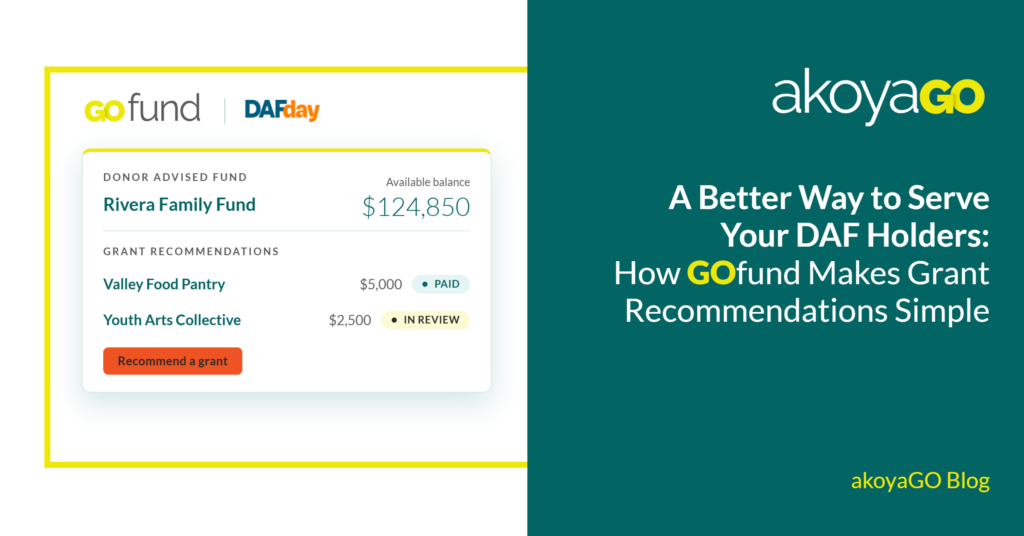
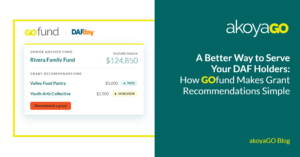
A Better Way to Serve Your DAF Holders: How GOfund Makes Grant Recommendations Simple
DAF holders now account for nearly 25% of all charitable giving in the United States. Are yours able to recommend grants, check their balance, and stay connected to your foundation without picking up the phone? Here’s how GOfund makes that possible.
Ameliea Dulaney brings more than seven years of marketing experience rooted entirely in the philanthropic sector. Her career began at a small nonprofit in her hometown, where a lifelong passion for mission-driven work and a natural gift for storytelling found their professional home. Over the years she built her expertise across multiple nonprofit organizations before transitioning into the foundation world, where she led marketing for a community foundation. That experience gave her a deep, firsthand understanding of how foundations operate, what they need, and how to communicate their impact. She joined akoyaGO to bring that perspective to the technology side of philanthropy, helping foundations do good better.